4.8

Sherlock
Hunt down social media accounts by username across social networks
SHARE
Screenshots (1)
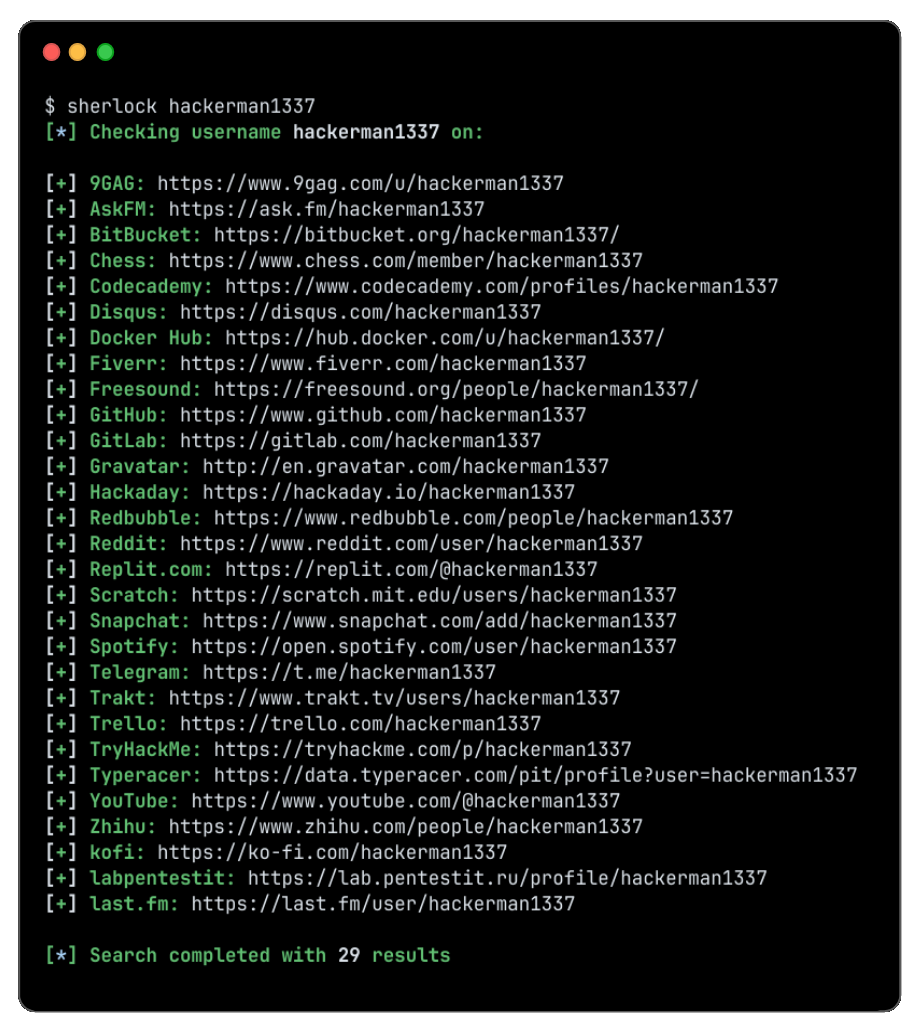
Screenshot 1 of 1
Overview
Sherlock is an open-source, high-performance solution engineered to solve foundational workflow challenges in the Python ecosystem. Built on local-first principles to ensure privacy, performance, and complete data ownership, it provides a unified architecture for modern developers and technical power users.
How It Works
Sherlock operates through structured, deterministic execution stages:
Target Identification: Ingests target username and loads an extensive database of over 400 social network signatures and URL patterns.
Concurrent Probe Dispatch: Issues asynchronous HTTP requests across supported platforms with intelligent rate limiting and proxy rotation.
HTTP Response & Content Analysis: Evaluates HTTP status codes, error messages, and page fingerprints to differentiate active accounts from false positives.
Structured OSINT Reporting: Aggregates verified profile URLs into categorized terminal tables, CSV spreadsheets, and machine-readable JSON files.
Key Technical Features & Capabilities
High-Performance Architecture: Engineered on top of Python, cli, cti, minimizing runtime latency and resource overhead.
Local-First Reliability: Executes core workloads locally on host hardware with zero unexpected external telemetry or cloud vendor lock-in.
Extensible Modularity: Cleanly decoupled module boundaries enable rapid integration, custom scripting, and plugin ecosystem extensibility.
Standardized Developer Tooling: Incorporates automated dependency workflows, reproducible builds, and developer-friendly CLI hooks.
Architecture & Technology Stack
Primary Languages: Python, cli, cti
Build Systems & Runtimes: Python 3.10+ / uv / virtualenv (uv / pip / poetry)
Supported Platforms: macOS (Apple Silicon & Intel), Windows 10/11 x64, Linux
System Requirements
| Specification | Minimum Requirement | Recommended Specification |
|---|---|---|
| Operating System | macOS 12.0+ / Windows 10 x64 / Ubuntu 22.04 | macOS 14.0+ Sonoma / Windows 11 x64 |
| Processor Architecture | 4-Core x86_64 or Apple Silicon M1 | 8-Core Apple Silicon / Core i7+ |
| Memory (RAM) | 4 GB Unified Memory | 16 GB+ High-Speed RAM |
| Disk Space | 1 GB free SSD storage | 5 GB+ free SSD storage |
Installation & Setup Guide
macOS Installation
1
Download verified release installer from CookApps or upstream releases.
2
Drag application package into
/Applications.Windows Installation
1
Download official setup binary (
.exe / .msi).2
Run installer and launch from Start Menu.
Building from Source
bash
git clone https://github.com/sherlock-project/sherlock.git
cd sherlock
pip install -e .
How to Use & Workflow
1
Application Launch: Launch Sherlock to initialize runtime state and local storage caches.
2
Configuration & Workspace: Set up local configuration, environment flags, or CLI paths.
3
Execution Workflow: Execute automated pipelines or interact through the visual interface.
4
Data Verification: Review generated outputs stored deterministically in designated directories.
Troubleshooting & Common Issues
Issue: Port or Resource Collision on Startup.
*Cause*: A zombie process or background daemon is holding active port bindings.
*Resolution*: Terminate holding processes before relaunching the application.
Issue: Missing native toolchain dependencies during build.
*Cause*: Host system lacks C++ or platform compilation tools.
*Resolution*: Install Xcode Command Line Tools (macOS) or Visual Studio Build Tools (Windows).
How to Use & Getting Started
## Installation & Setup Guide
### macOS Installation
1. Download verified release installer from CookApps or upstream releases.
2. Drag application package into `/Applications`.
### Windows Installation
1. Download official setup binary (`.exe` / `.msi`).
2. Run installer and launch from Start Menu.
### Building from Source
```bash
git clone https://github.com/sherlock-project/sherlock.git
cd sherlock
pip install -e .
```
Ready to run Sherlock?
100% Free & Open-Source native desktop software. Star the repository to support development.