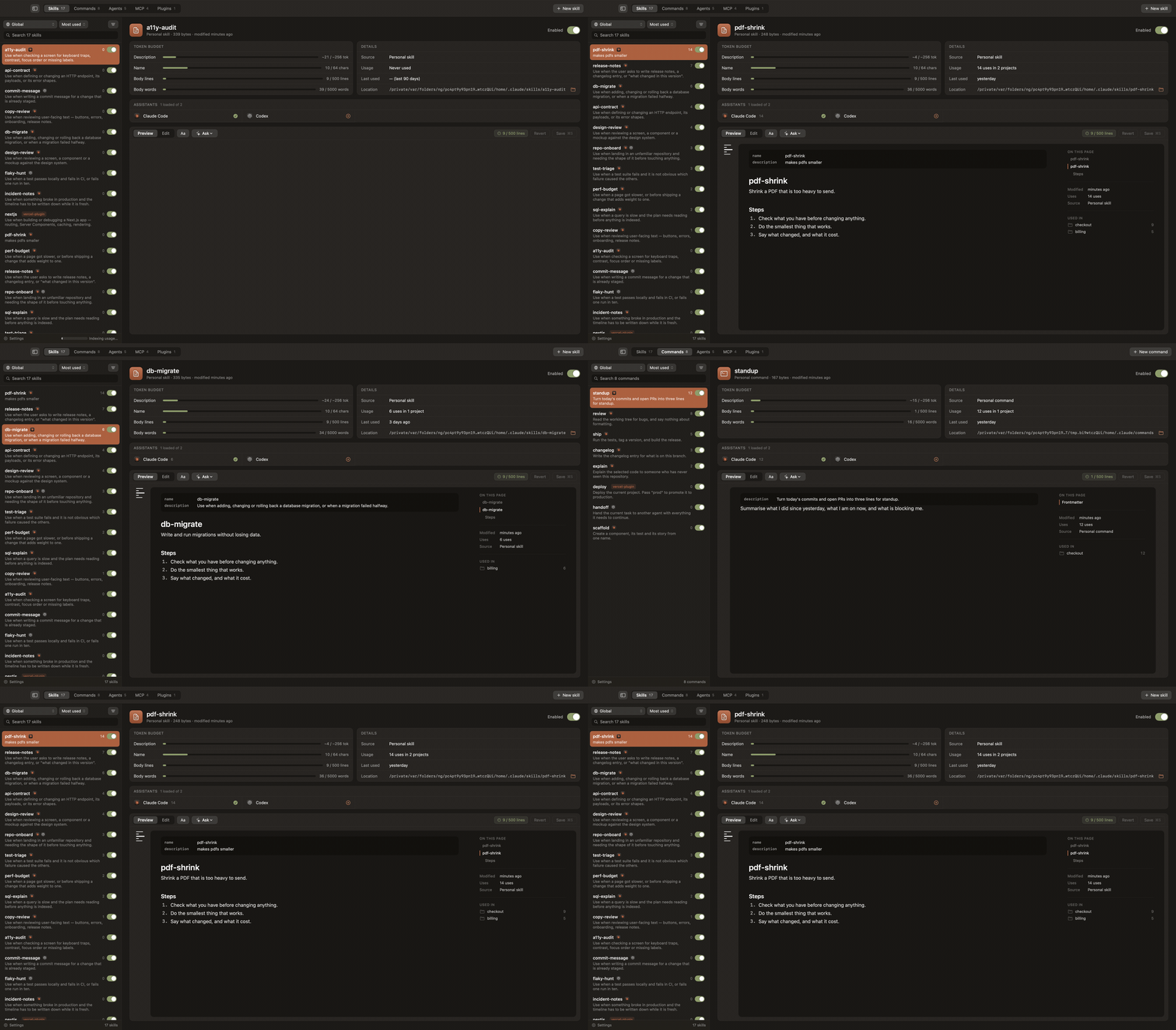
Inspects and manages the skills, slash commands, subagents, plugins and MCP servers that coding assistants load, with usage counts read from session logs.
SHARE
Screenshots (5)
Screenshot 1 of 5
Overview
Loadout See and manage what your coding assistants load. Skills, slash commands, subagents, plugins and MCP servers, from every assistant on the machine — with how often each one actually fires, and an editor for the ones you own. loadout.migsilva.dev — what it does, guides and download ``bash brew install --cask migsilva89/loadout/loadout ` Or [download the DMG](../../releases/latest) and drag Loadout.app into /Applications`. Signed and notarised; macOS 15 or later.
Loadout is built on open-source principles to guarantee security, privacy, and full reproducibility. All sensitive data transformations run locally on your hardware with zero telemetry or unexpected cloud dependencies.
Key Technical Features & Capabilities
A full inventory — personal and project skills, everything from plugins, slash commands, subagents and MCP servers, across every assistant on the machine — Claude Code, Codex and Antigravity MCP servers side by side, each marked with its owner: Streamlined desktop functionality optimized for macOS and Windows.
Real usage — how many times each thing fired, when it last did, and in how many projects, read from the assistants' own session logs: Streamlined desktop functionality optimized for macOS and Windows.
Honest counts — a history format that cannot prove an activation is marked unsupported, rather than reporting a zero that looks like disuse: Streamlined desktop functionality optimized for macOS and Windows.
Project scope — answers "what does an assistant see if I open this folder?" — and an Everything list that puts yours and every project's side by side, each row saying where it lives, for when the question is "where did I put that one?": Streamlined desktop functionality optimized for macOS and Windows.
A switch on everything — turn one skill, command, subagent or MCP server off without deleting it, including a single skill out of a 38-item plugin, and Loadout re-applies that choice when the plugin updates: Streamlined desktop functionality optimized for macOS and Windows.
Codex plugins — installed plugins and their skills appear alongside Claude's, with separate controls. Turning off a plugin shows all its skills as off; turning it back on restores your individual choices. Codex's local plugin controls require an installed Codex version that supports its plugin inventory protocol. Workspace-managed plugin switches stay in Codex.: Streamlined desktop functionality optimized for macOS and Windows.
An editor — create skills, commands and subagents, edit and delete them, with syntax highlighting and live validation against the documented limits: Streamlined desktop functionality optimized for macOS and Windows.
**A conversation, beside the editor — ask claude, codex, opencode or agy to change a skill; it proposes, you accept change by change**: Streamlined desktop functionality optimized for macOS and Windows.
Architecture & Technology Stack
Primary Languages: Swift
Frameworks & UI Runtime: SwiftUI / AppKit
Build Systems & Tooling: Xcode / Node.js / Cargo
Supported Platforms: macOS 12.0+ (Apple Silicon M1-M4 & Intel x86_64), Windows 10/11 x64, Linux
System Requirements
Specification
Minimum Requirement
Recommended Specification
Operating System
macOS 12.0 Monterey / Windows 10 x64
macOS 14.0+ Sonoma / Windows 11 x64
Processor Architecture
Apple Silicon (M1+) or Intel Core i5 x64
Apple Silicon Unified Memory (M2/M3/M4)
Memory (RAM)
4 GB Unified RAM
8 GB+ High-Speed RAM
Storage Space
300 MB available local disk space
1 GB+ SSD storage
GPU Acceleration
Metal 2 / DirectX 12 compatible
Apple Neural Engine / Vulkan capable
Installation & Setup Guide
1 Redit
macOS Installation (Recommended)
1
Download the verified .dmg release installer directly from CookApps.
2
Open the disk image and drag Loadout.app into your /Applications folder.
3
Launch Loadout via Spotlight (Cmd + Space) or Launchpad.
Alternatively, install using Homebrew if available:
bash
brew install --cask migsilva89/loadout/loadout
Windows Installation
1
Download the official installer package (.exe / .msi).
2
Run the executable and follow the setup wizard.
3
Launch Loadout from the Start Menu or desktop shortcut.
Building from Source (Development Setup)
bash
git clone https://github.com/user-attachments/assets.git
cd assets
pnpm install || cargo build --release
pnpm run build
Installation & Setup Guide
Mở khóa ứng dụng để xem chi tiết hướng dẫn cài đặt, cấu hình môi trường và vận hành.
How to Use & Workflow
1 Redit
1
Application Launch & Workspace: Open Loadout to load the responsive native workspace.
2
Configuration & Preferences: Press Cmd + , (macOS) or Ctrl + , (Windows) to configure hardware acceleration, custom directories, and display themes.
3
Primary Operation: Drag-and-drop source files or input parameters directly into the central window.
4
Execution & Export: Initiate the processing pipeline and verify output files saved directly to your chosen local directory.
How to Use & Workflow
Mở khóa ứng dụng để xem chi tiết hướng dẫn cài đặt, cấu hình môi trường và vận hành.
Troubleshooting & Common Issues
Problem: macOS Gatekeeper displays *"App is damaged and can't be opened"* or unnotarized developer notice.
Root Cause: macOS quarantine flag set on binaries downloaded outside the Mac App Store.
Resolution: Open Terminal and run:
bash
xattr -cr /Applications/Loadout.app
Alternatively, navigate to System Settings > Privacy & Security and select Open Anyway.
Problem: High memory consumption during batch processing operations.
Root Cause: Large media buffers retaining uncompressed state.
Resolution: Adjust batch concurrency in settings or process assets in focused batches.
How to Use & Getting Started
Protected
## Installation & Setup Guide
### macOS Installation (Recommended)
1. Download the verified `.dmg` release installer directly from CookApps.
2. Open the disk image and drag **Loadout.app** into your `/Applications` folder.
3. Launch Loadout via Spotlight (`Cmd + Space`) or Launchpad.
Alternatively, install using Homebrew if available:
```bash
brew install --cask migsilva89/loadout/loadout
```
### Windows Installation
1. Download the official installer package (`.exe` / `.msi`).
2. Run the executable and follow the setup wizard.
3. Launch **Loadout** from the Start Menu or desktop shortcut.
### Building from Source (Development Setup)
```bash
git clone https://github.com/user-attachments/assets.git
cd assets
pnpm install || cargo build --release
pnpm run build
```
How to Use & Getting Started
Unlock this app with 1 Redit to access verified runbooks and usage workflows.
Ready to run Loadout?
100% Free & Open-Source native desktop software. Star the repository to support development.