JUMP is built on open-source principles to guarantee security, privacy, and full reproducibility. All sensitive data transformations run locally on your hardware with zero telemetry or unexpected cloud dependencies.
Key Technical Features & Capabilities
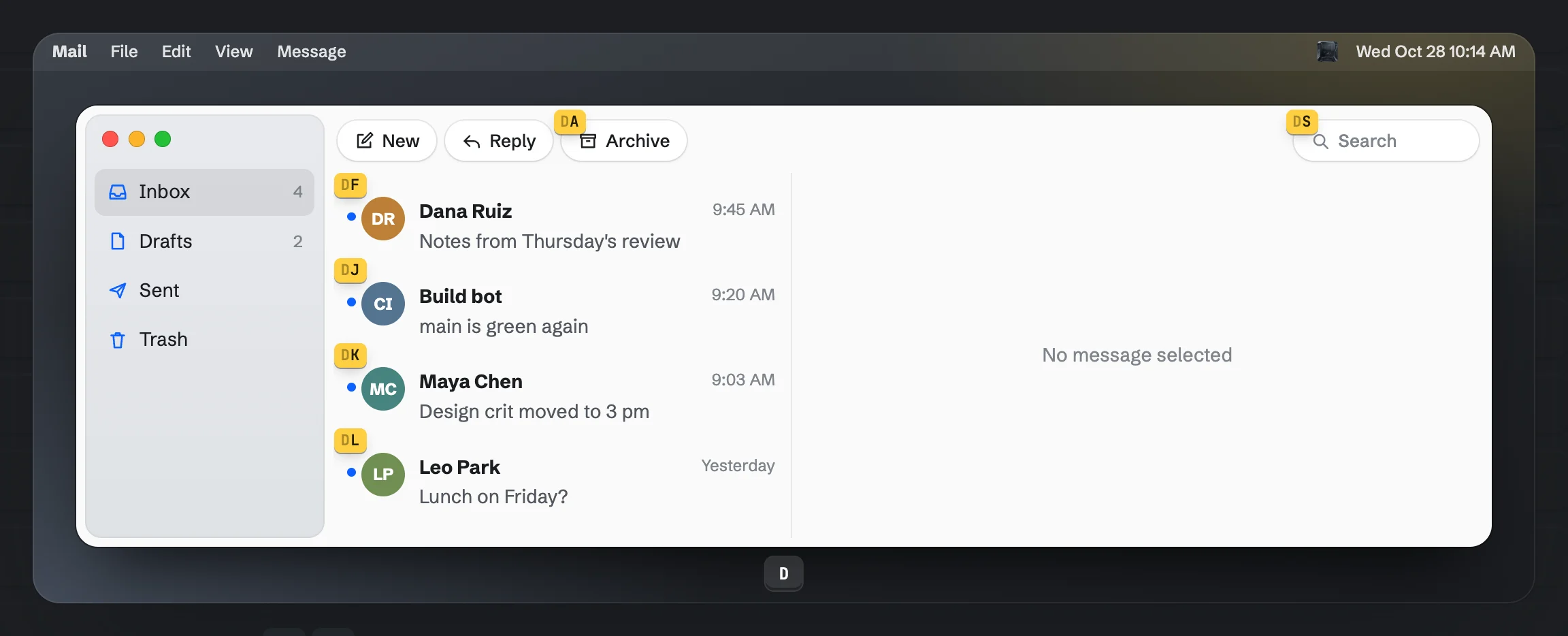
**Actions with modifiers. Holding a modifier while typing a label (or pressing Return in text search) chooses the action**: none clicks (or places the caret in a text field), Shift right-clicks, ⌘ double-clicks, ⌥ only moves the pointer. Each action's modifier (Shift, ⌃, ⌥ or ⌘) can be changed in Settings, Behavior. Clicks wait until the modifier is released, so apps never see it.
Text search reads text through Accessibility. Matching ignores case and accents, and only counts what is on screen.: Streamlined desktop functionality optimized for macOS and Windows.
OCR fallback (optional). For windows without usable Accessibility text (terminals, PDFs, images), JUMP can recognize text on screen. It is off by default and needs the Screen Recording permission, requested only when you turn it on. Captures never leave memory.: Streamlined desktop functionality optimized for macOS and Windows.
Appearance. Five hint themes (Dark, Light, System, Accent, Classic) with readable contrast, label size from 7 to 20 pt, upper or lower case labels, and Liquid Glass (Off, Regular, Clear). Scroll speed (Slow, Normal, Fast) and the scroll area outline can be changed in Behavior.: Streamlined desktop functionality optimized for macOS and Windows.
App. Three menu bar icons, optional Dock icon (official or glyph), launch at login.**: High-performance integrated capability designed for native JUMP workflow.
Update notices. JUMP asks GitHub for the latest release (every day by default; every 6 hours, every week or off in Settings, General). When a new version is out, the menu bar menu offers to download it, and Settings marks the version as outdated and lists what's new. It doesn't install anything itself: Homebrew users run brew upgrade --cask jump, everyone else downloads the new DMG.
Leaves the mode when focus moves, whether by mouse, ⌘-Tab, ⌘\` or a window manager such as AeroSpace.: Streamlined desktop functionality optimized for macOS and Windows.
Architecture & Technology Stack
Primary Languages: Swift
Frameworks & UI Runtime: SwiftUI / AppKit
Build Systems & Tooling: Xcode / Node.js / Cargo
Supported Platforms: macOS 12.0+ (Apple Silicon M1-M4 & Intel x86_64), Windows 10/11 x64, Linux
System Requirements
Specification
Minimum Requirement
Recommended Specification
Operating System
macOS 12.0 Monterey / Windows 10 x64
macOS 14.0+ Sonoma / Windows 11 x64
Processor Architecture
Apple Silicon (M1+) or Intel Core i5 x64
Apple Silicon Unified Memory (M2/M3/M4)
Memory (RAM)
4 GB Unified RAM
8 GB+ High-Speed RAM
Storage Space
300 MB available local disk space
1 GB+ SSD storage
GPU Acceleration
Metal 2 / DirectX 12 compatible
Apple Neural Engine / Vulkan capable
Installation & Setup Guide
macOS Installation (Recommended)
1
Download the verified .dmg release installer directly from CookApps.
2
Open the disk image and drag JUMP.app into your /Applications folder.
3
Launch JUMP via Spotlight (Cmd + Space) or Launchpad.
Alternatively, install using Homebrew if available:
bash
brew install --cask alvaldes/tap/jump
Windows Installation
1
Download the official installer package (.exe / .msi).
2
Run the executable and follow the setup wizard.
3
Launch JUMP from the Start Menu or desktop shortcut.
Building from Source (Development Setup)
bash
git clone https://github.com/alvaldes/jump.git
cd jump
pnpm install || cargo build --release
pnpm run build
How to Use & Workflow
1
Application Launch & Workspace: Open JUMP to load the responsive native workspace.
2
Configuration & Preferences: Press Cmd + , (macOS) or Ctrl + , (Windows) to configure hardware acceleration, custom directories, and display themes.
3
Primary Operation: Drag-and-drop source files or input parameters directly into the central window.
4
Execution & Export: Initiate the processing pipeline and verify output files saved directly to your chosen local directory.
Troubleshooting & Common Issues
Problem: macOS Gatekeeper displays *"App is damaged and can't be opened"* or unnotarized developer notice.
Root Cause: macOS quarantine flag set on binaries downloaded outside the Mac App Store.
Resolution: Open Terminal and run:
bash
xattr -cr /Applications/JUMP.app
Alternatively, navigate to System Settings > Privacy & Security and select Open Anyway.
Problem: High memory consumption during batch processing operations.
Root Cause: Large media buffers retaining uncompressed state.
Resolution: Adjust batch concurrency in settings or process assets in focused batches.
How to Use & Getting Started
## Installation & Setup Guide
### macOS Installation (Recommended)
1. Download the verified `.dmg` release installer directly from CookApps.
2. Open the disk image and drag **JUMP.app** into your `/Applications` folder.
3. Launch JUMP via Spotlight (`Cmd + Space`) or Launchpad.
Alternatively, install using Homebrew if available:
```bash
brew install --cask alvaldes/tap/jump
```
### Windows Installation
1. Download the official installer package (`.exe` / `.msi`).
2. Run the executable and follow the setup wizard.
3. Launch **JUMP** from the Start Menu or desktop shortcut.
### Building from Source (Development Setup)
```bash
git clone https://github.com/alvaldes/jump.git
cd jump
pnpm install || cargo build --release
pnpm run build
```
Ready to run JUMP?
100% Free & Open-Source native desktop software. Star the repository to support development.